
Spring in the Elsinore Valley brings one of the most common urgent pest calls Main Sail Pest Control receives: a homeowner has found what looks like a bee or wasp nest on their property and needs to know whether to treat it themselves, leave it alone, or call immediately. The answer depends almost entirely on what species it is – and getting that wrong has consequences ranging from a painful sting to a genuinely dangerous encounter. Lake Elsinore and the surrounding Inland Valley have a specific stinging insect profile that includes some species you can largely ignore, some you should treat carefully, and at least one that requires immediate professional attention. The ability to tell them apart before acting is the most useful thing this post can provide.
Paper Wasps: The Nests Most People Can Actually Coexist With
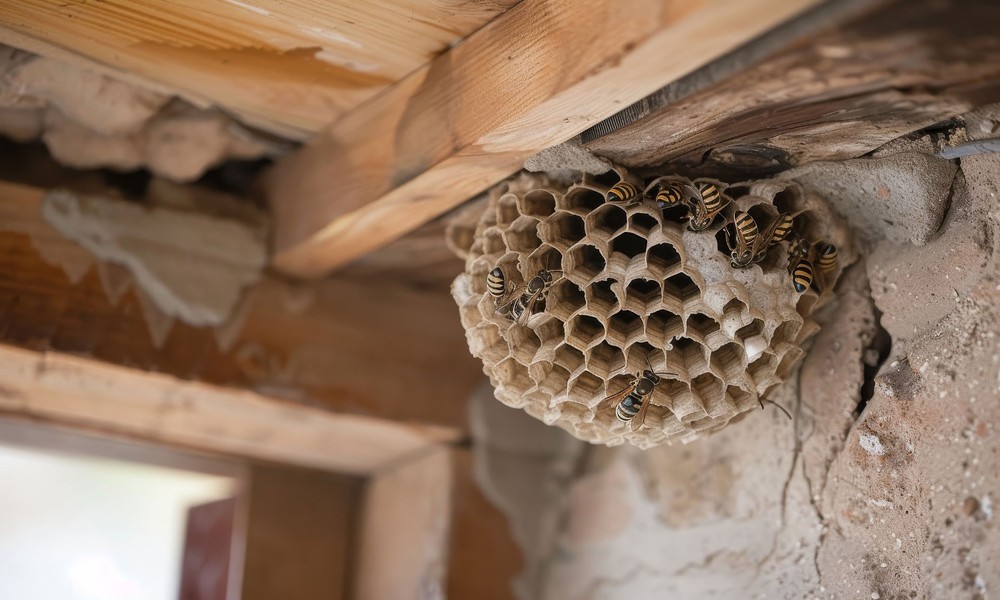
Paper wasps (Polistes species) are the slender, narrow-waisted wasps that build the small, open-celled nests that look like an upside-down comb – gray, papery, roughly the diameter of a saucer when small, occasionally larger by late summer. These nests are commonly found under eaves, in patio cover corners, in garage door header spaces, and on fence posts or railing undersides.
Paper wasps are not aggressive unless directly threatened. A paper wasp foraging in the garden or flying near the patio is not a stinging event waiting to happen. They will defend the nest if you get close to it, reach near it, or vibrate the surface it’s attached to – but they don’t follow you away from the nest or attack unprovoked the way yellow jackets do.
From an ecological standpoint, paper wasps are genuinely beneficial: they prey on caterpillars, beetles, and other insects that damage garden plants. A small paper wasp nest in a back corner of a pergola that isn’t in a high-traffic area is something many homeowners reasonably choose to leave alone until the season ends. Queens don’t reuse old nests the following year, and an empty nest in winter can simply be knocked down.
When paper wasps become a problem: nests directly over an entry door, near a play area, or in any location where regular human activity brings people within a foot or two of the nest. At that proximity, stings become a realistic risk. Children and pets who don’t yet understand what the nest is are particularly at risk.
Yellow Jackets: The Species That Warrants Actual Caution
Yellow jackets (Vespula and Dolichovespula species) are the wasps responsible for most of the picnic and outdoor event stinging incidents in Southern California. They’re the wasps that hover around open soda cans, pursue food at outdoor tables, and will sting repeatedly and aggressively without provocation once a colony is large enough to be territorial.
Yellow jackets nest in a wider variety of locations than paper wasps. Ground nests – colonies inside soil or under concrete slabs – are common. Wall voids inside structures, attic spaces, and the hollow space inside outdoor furniture or planters are all documented nesting sites. The papery nest envelope that encloses yellow jacket colonies is often hidden inside these spaces and not visible from the outside; what homeowners notice is wasp traffic going in and out of a hole in the ground, a gap in the eave, or an opening in a wall.
By mid-summer, a well-established yellow jacket colony can contain thousands of workers and will respond to perceived threats – including vibration from nearby lawn equipment, or a foot coming down near a ground nest – with rapid, coordinated defense that can involve dozens of stings. This is not a species to attempt to treat with consumer wasp spray unless the nest is small, clearly visible, and accessible without standing under or directly in front of it. Night treatment when workers are less active is the standard professional approach.
Africanized Honey Bees in the Inland Valley: A Genuine Safety Issue
The Inland Valley including the Lake Elsinore area sits within the established range of Africanized honey bees – the hybridized population that has been present in Southern California since the 1990s. Africanized honey bees look essentially identical to European honey bees; the only reliable way to distinguish them is through laboratory analysis of the bee’s DNA or wing morphology.
What distinguishes Africanized bees behaviorally is their defensive response. European honey bee colonies will defend a nest if directly disturbed, but the defensive zone is relatively compact. Africanized colonies defend a much larger territory, respond to disturbance more rapidly, and will pursue perceived threats for longer distances – in documented cases, hundreds of yards. Attacks by established Africanized colonies have caused serious injury and deaths, particularly in cases where the victim could not exit the area quickly.
This matters for Lake Elsinore homeowners because swarms and established colonies in the Inland Valley have a meaningful probability of being Africanized, particularly in natural areas adjacent to residential development. A swarm resting on a fence post is usually calm and temporary – swarms don’t have a nest to defend and typically move on within 24 to 48 hours. An established colony inside a wall void, in the eave of a structure, or in an irrigation box in the yard is a different situation. Any bee colony in a structural void or in a location with regular foot traffic should be treated as potentially Africanized until confirmed otherwise.
The standard advice holds: don’t poke it, spray it with a garden hose, or attempt to seal the entrance without understanding what’s behind it. A sealed entrance forces bees to find another exit point, which may be inside the living space of the house.
What DIY Attempts Typically Lead To
Consumer wasp sprays work on small paper wasp nests when applied at the correct time, from a safe distance, with a clear escape route. That’s the scenario they’re designed for. Outside of that specific situation, DIY attempts create problems.
Spraying a yellow jacket ground nest during the day when workers are active typically results in multiple stings and an incomplete kill. Workers underground are not reached by the surface application, and the colony is now alerted and defensive. Coming back the next day with more spray doesn’t usually solve it – it escalates the agitation.
Spraying a suspected bee colony in a wall void creates a different problem: dead bees inside a wall attract dermestid beetles, release honey that ferments and seeps through drywall, and can require the removal of significant wall material to clean out. Professional bee removal from a structure involves treating the colony and removing the comb – treating only the bees and leaving the wax behind creates ongoing problems that can last for years.
When Calling Main Sail Pest Control Is the Right Move
Any stinging insect nest that is inside a wall, ceiling, or floor void. Any nest that is directly over an entry point to the home. Any bee swarm that hasn’t moved within 48 hours. Any bee colony that appears well established (significant traffic, comb visible, colony that’s been present for more than a few weeks). Any situation involving children, elderly residents, or anyone with a known allergy to stinging insect venom.
Main Sail Pest Control serves Lake Elsinore and the surrounding communities for wasp nest removal and treatment. We offer same-day service and free estimates. Contact us if you’ve found a nest that doesn’t feel like something to handle independently.